
Going to school in the 1980s and 90s put me at the head of the computer curve. I was there at the heyday of computer development; the BBC Micro – when a floppy disk really was floppy, the Spectrum ZX 128K (with cassette, obviously), dial up internet with that crazy scratchy sound effect that told you something was happening. Youngsters were programming computers, mobile phones were just beginning to emerge and the mullet was a hairstyle on the decline.
I am not, it turns out, a natural technologist. The novelty of the Spectrum computer wore off, the floppy discs kept corrupting on the school BBC Micro and I waited well into the new millennium before acquiring my first mobile phone.
The truth is, I don’t like tech. And I’m pretty sure I’m not alone. In our other blog earlier this month on the changes that Artificial Intelligence is bringing, technology seems to be evolving at an ever-faster rate and I am in no way keeping up. Now generally speaking, this is not really a problem; I don’t need to have the latest smartwatch rigged up to my heart rate or a smart speaker that talks to my tv that talks to my phone. And if I do decide to invest in this sort of tech, I can hand them to my 8-year-old daughter who will explain to me how to set them up.
No, the problem arises when businesses start to make changes, when new software packages are introduced. That’s when some people’s eyes glaze over and hearts sink. We often hear in the businesses we work with “But I’ve only just got to grips with the last change we made” or “What was wrong with the way we have always done it?”. It’s an unfortunate response! I’m generally quite good at embracing change but there’s something about a new IT process that brings out the donkey in me. But, hearing this in so many of the employee engagement surveys we run, I know I’m not alone in this!
So, how do we help others to embrace change and understand how we take them on the journey with us. The key is to get them involved early on in the process.
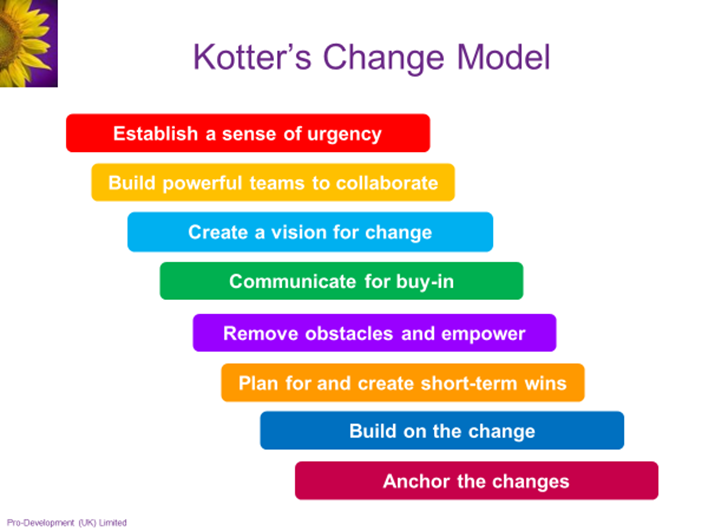
Lee wrote a blog a few months ago, How to coach your team and support them through changing times that explores how we can help support people through change but we also recommend Kotter’s 8 step change model for successful implementation of change.
The diagram below shows the 8 steps and what we find is that people often start at step 4 and communicating for buy-in, but the first three steps that are absolutely key in getting people engaged and involved early on and helping them to understand the change – missing these 3 steps are often the cause of resistance to change in our experience.
Another way to engage people is to understand what is leading to their engagement at the moment. What is it that is contributing to their happiness and productivity at work but also, what might be getting in the way. Without this knowledge, it can be challenging to implement change.
An employee engagement survey is a great tool to identify just where everyone is at right now, what your baseline is, what you are doing that is taking people with you and what, if anything, are the obstacles that are getting in people’s way. The resulting outcome of a survey, in fact the most fundamental aspect of the project, is an Action Plan for the year ahead. This is hugely valuable, as the plan can help to connect people back to why change is being implemented, knowing that they had a voice in this. If your people have had a say, they are much more likely to embrace the future.
Alternatively, how about a team building day together where you can have the chance to explore the vision, where you are heading, what might get in the way and together, work through these challenges, understand where you are each at and what you need to help move you forward together and then develop a plan together for the future. It can make a big difference.
If either of these are something you would benefit from, please do get in touch to see how we can help.
Written by: Rob Gooch
Published: 10 October 2023
Blog Articles
Why DiSC Team Days Are a Game-Changer for Connection and Performance
Why every leader should take their team into the countryside for more than just fresh air
Employee wellbeing: Why it matters more than ever in businesses today
Burnout in your team is costing your business more than you think
Dare to go there! What really happens in coaching and why it works
“I haven’t got time for this” – why taking time for coaching matters
How much can you really learn in a day?
The power of quick wins in professional development
Why consultancy matters: The catalyst for clarity, growth and smarter decisions
I found the workshop very beneficial. Sue has a very friendly and amiable approach and the course content was very relevant. There is lots to take away and material for further study. The interactive approach is very interesting and engaging. Thank you!
I found that I gained the understand... more
Building Relationships and Influencing Others Attendees
You may also like...